Dionysos: The greatest truths often sound like babblings of madmen- till they are understood.
___________________________
Chorus:
... What does it mean to live a life?
Can you hope for better than to rise above all warring,
Control what threatens you,
Defeat what oppresses you?
To be strong-
No, nothing is better
I choose that.
Life is a stormy sea,
Happiness is a harbour.
Finding your harbour is your life-work.
He is truly happy who succeeds in that life-work.
Some end rich, some poor,
Some are strong, some achieve nothing.
There are ten thousand hopes, then thousand dreams,
They may all come true- they may all vanish,
But happiness-
A man finds happiness when he lies every day
With those forces of the world on his side.
All hail to that man!
_________________________
Chorus: ...Live easy, live calm, and the storm can't wreak you-
_________________________
Chorus:
... He {Dionysos} hates the man who says no.
No to the day,
No to the night,
No to life, and no to all love-
Keep away from that kind,
They are too much for you, they will consume you.
There is another way, never named, never mapped.
But the unheard-of, untalked-of people follow it.
That way I choose- I say yes to it.
_________________________
Chorus:
The forces of life are seen in disguise,
A thousand disguises.
They make all things possible,
They guarantee nothing,
What you thought was forgotten, buried,
They conceive, and bring to birth again.
Today you have watched their power at work-
It never ends.
Saturday, August 23, 2008

Monday, August 18, 2008
Long Day's Journey Into Night by Eugene O'Neill (Baudelaire's)
Be drunken, if you would not be martyred slaves of Time; be drunken continually! With wine, with poetry, or with virtue, as you will.
Friday, August 15, 2008
More Leonardo...
I have seen in the clouds and on walls stains which have stimulated me to make beautiful discoveries of various things, and which, though in themselves completely devoid of perfection in the representation of any particular detail, did not lack perfection in movement and other activity.
Note Books (Leonardo da Vinci) p.136
O time, swift despoiler of created things! How many kings, how many peoples hast though brought low! How many changes of stage and circumstance have followed since the wondrous form of this fish died here in this hollow, winding recess? Now destroyed by time patiently though liest within this narrow space, and with thy bones despoiled and bare art become and armour and support to the mountain which lies above thee.
Tuesday, August 12, 2008
MTV True Life: I'm Deaf
Call me insane, but MTV True Life and Made make me well up more than any other television program. I really get into the "characters". Last night I watched MTV True Life: I'm Deaf and fell in love with Chris. If I was sixteen I'd totally be into him.
Sunday, August 10, 2008
Dark Knight
I went to see Dark Knight (along with Kung Fu Panda and a portion of Hancock) at the Vali-Hi drive-in at Lake Elmo this weekend. It was fitting, as it was also where I saw Batman Begins years ago. It was a near perfect movie for the superhero genre- truly a masterpiece. The story contained the perfect balance of action, plot, and philosophy that makes all our great superhero stories great. Depressing? Yes. One could argue the Joker "won" with the movie ending in mayhem for Gotham and our hero on the run. However, it could be argued that we are at the place in our society where that story "feels right"- certainty more so than a squeaky clean superhero who saves the day from a clear-cut bad guy with clear-cut immoral plots and plans.
At first I was skeptical at the hype, especially for Heath Leger's performance. I thought surly the Oscar buzz was only a posthumous nod of respect. Not so. He truly transformed himself and the roll of the Joker. There is somewhat of a highbrow attitude that poo-poos superhero/action/blockbuster movies; however, Ledger not only created the ultimate villain, he created the best character and delivered the best performance from an actor that I have seen in a very long time. (James compared it to De Niro in Taxi Driver.) I am saddened that I will not be able to see more of this artist, especially in this roll. (Will they retire this villain or find another? And if so, who? Johnny Depp? Daniel Day-Lewis? Could they touch his brilliance?)
Also, ALSO, who knew he was that good until the Joker? Yes we saw potential in Brokeback Mountain, but lets not forget this:
It's amazing to be able to see an actor grow as an artist (himself, the instrument, as well as the rolls the industry allows him to play). Truly, truly amazing.
Wednesday, August 6, 2008
Ra Ra Riot
Ra Ra Riot, a Syracuse band, released a new album, which was reviewed by Rolling Stone.
I saw the band play at a house party in Syracuse (1217) which almost took down the house with it. The drummer, John Ryan Pike, was a dear, dear soul. I did not know him well, but he was the type of person who emitted kindness. I'm really happy his band is doing well.
I saw the band play at a house party in Syracuse (1217) which almost took down the house with it. The drummer, John Ryan Pike, was a dear, dear soul. I did not know him well, but he was the type of person who emitted kindness. I'm really happy his band is doing well.
Drill Here/Drill Now
I will cry if someone this witty (or has writers this witty) isn't voted as our President.
Pulp Fiction
There are playing Pulp Fiction, a favorite, on TNT. I had to YouTube this scene and watch it another time I love it so much.
I desperately want to dance with someone like this... just as seriously.
I desperately want to dance with someone like this... just as seriously.
Sunday, August 3, 2008
The Theater and Its Double by Antonin Artaud P.107
 It has not been definitively proved that the language of words is the best possible language. And it seems that on the stage, which is above all the space to fill and a place where something happens, the language of words may have to give way before a language of signs whose objective aspect is the one that the most immediate impact upon us.
Considered in this light, the objective work of the mise en scene assumes a kind of intellectual dignity from the effacement of words behind gestures and from the fact that the esthetic, plastic part of theatre drops its role of decorative intermediary in order to become, in the proper sense of the word, a directly communicative language.
Great Reckonings in Little Rooms by Bert O. States
Modes of Performance:
1) Self- Expressive: In the self-expressive mode the actor seems to be performing on his own behalf. He says, in effect, “See what I can do.” Whatever they are about is less than what is on display (opera, dance, mime). Found in certain rolls (many leads in Shakespeare), certain actors (Sarah Bernhardt), etc. The actor finds a fissure in the text that allows him to make his unique contribution.
2) Collaborative: to break down the distance between the actor and the audience and to give the spectator something more than a passive role in the theater exchange. “Why should we pretend that all this is an illusion. We are in this together.”
3) Representational: the drama of the subject. The actors energies now are bent on becoming the character, and, for the audience, they cease to be artistic energies and become the facts of his character’s nature. The play is not a text, classic or brand-new, out of which theater magic can be made; it is now an enactment of significant human experience. The virtuosity now lies in the power of the subject.
p. 182: "I should emphasize that my treatment of these three modes as if they occurred purely is strictly a convenience of definition. It is precisely our ability to integrate them or to arrest on or another of them in our perceptual attention that lends the unique depth and texture to the theater experience."
1) Self- Expressive: In the self-expressive mode the actor seems to be performing on his own behalf. He says, in effect, “See what I can do.” Whatever they are about is less than what is on display (opera, dance, mime). Found in certain rolls (many leads in Shakespeare), certain actors (Sarah Bernhardt), etc. The actor finds a fissure in the text that allows him to make his unique contribution.
2) Collaborative: to break down the distance between the actor and the audience and to give the spectator something more than a passive role in the theater exchange. “Why should we pretend that all this is an illusion. We are in this together.”
3) Representational: the drama of the subject. The actors energies now are bent on becoming the character, and, for the audience, they cease to be artistic energies and become the facts of his character’s nature. The play is not a text, classic or brand-new, out of which theater magic can be made; it is now an enactment of significant human experience. The virtuosity now lies in the power of the subject.
p. 182: "I should emphasize that my treatment of these three modes as if they occurred purely is strictly a convenience of definition. It is precisely our ability to integrate them or to arrest on or another of them in our perceptual attention that lends the unique depth and texture to the theater experience."
Great Reckonings in Little Rooms by Bert O. States P.101
What is a revolutionary artist? Every artist to some extent sees things differently and therefore does something to the art paradigm in which he works, if only to help wear it out and prepare the ground for bolder developments. A completely nonrevolutionary art would be one that is reproduced social norms in a completely normative style (one of the risks of Soviet realism). “You are normal,” as Handke’s Prompter puts it, “once your story is no longer distinguishable from any other story.” (1) But a revolutionary artist is one who sees a distance between experience and the sign language of his art: “There is something art can’t talk about now.”
1 Handke, Kasper and Other Plays, p.80.
1 Handke, Kasper and Other Plays, p.80.
Meet Me In St. Louis (1944)
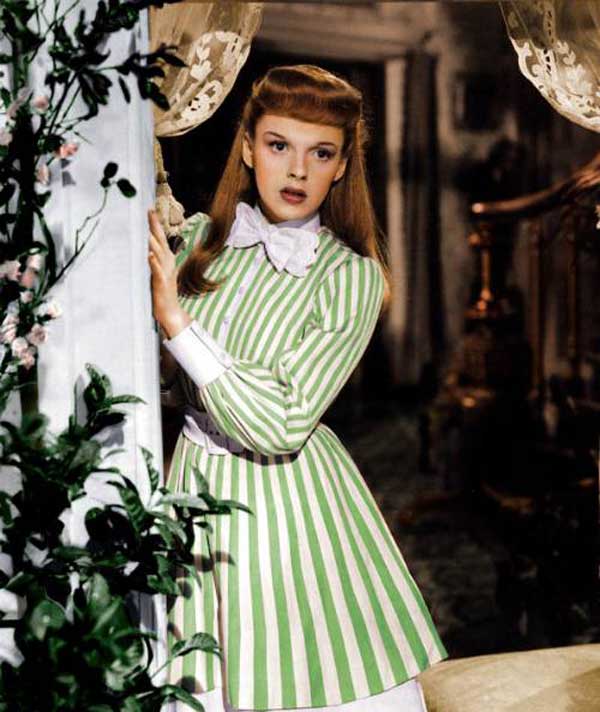
Director Vincente Minnelli’s masterpiece of Americana about the trials and tribulations of the St. Louis-dwelling Smith clan is one of the greatest American film musicales ever lensed. Judy Garland stars as Ester Smith, who just can’t ignore the boy next for (Tom Drake). Leon Ames is Papa Smith and young Margaret O’Brien is unforgettable as the rambunctious Tootie.
Though the complete decision maker, dad is the at most the enemy and at least the clown in the Smith Family. ("Anna, I'm curious, just when was I voted out of this family?") Interesting to compare masculine rolls from Double Indemnity to this film.
Lovely costumes.
Double Indemnity (1944)

Smitten insurance man Walter Neff (Fred MacMurray) plots the perfect murder with femme fatale client Phyllis Dietrichson (Barbara Stanwyck): Stage her husband’s “accidental” death to collect double indemnity on his life insurance, then abscond with the loot. But the lethal duo must first get past a crafty claims investigator (Edward G. Robinson) who senses something isn’t kosher. What ensues is a cat-and-mouse game with fatal consequences.
Film Noir. Beautiful lighting. I love the language and witty bantering between Walter and Phyllis. Men are the dominant sex, but women hold the power in their sexual prowess.
Phyllis: Mr. Neff, why don't you drop by tomorrow evening about eight-thirty. He'll be in then.
Walter Neff: Who?
Phyllis: My husband. You were anxious to talk to him weren't you?
Walter Neff: Yeah, I was, but I'm sort of getting over the idea, if you know what I mean.
Phyllis: There's a speed limit in this state, Mr. Neff. Forty-five miles an hour.
Walter Neff: How fast was I going, officer?
Phyllis: I'd say around ninety.
Walter Neff: Suppose you get down off your motorcycle and give me a ticket.
Phyllis: Suppose I let you off with a warning this time.
Walter Neff: Suppose it doesn't take.
Phyllis: Suppose I have to whack you over the knuckles.
Walter Neff: Suppose I bust out crying and put my head on your shoulder.
Phyllis: Suppose you try putting it on my husband's shoulder.
Walter Neff: That tears it.
Excerpt from The Dramatic Imagination by Robert Edmond Jones
It happens to each one of us at times to feel separated from ourselves, going through the business of living as if we were at once a character in a play and the actor who impersonates that character. Two people dwell in us, an outer self, a being who answers to the name of John Doe or Richard Row, a kind of character-part, so to speak, and an inner self, a mysterious essence, a hidden flame, a shy wild Harlequin who plays this part before the world. We feel the presence of this other self when some moment of stark reality strikes through the conventions of our everyday lives. There is no one who has not experienced at some time or other the sense of inward withdrawal. All life in indeed a play in which we act out our roles until the final curtain falls. This idea of the theatre goes deep. We recognize its truth in our inmost hearts. We know that it is true as we know that our souls are immortal. I am persuaded that the consciousness of a dual personality- the sense of otherness, of apartness, the sense that we are possessed, that another’s voice ever and again speaks through us- is a thing that is very common in human experience and that it is the only thing that separates us from the brutes. Perhaps it was the sense of theatre that made us human, ages ago.
If it is true- as Shakespeare makes that melancholy Jaques say- that all the world’s a stage, and all the men and women merely players, playing our many parts on “a vaster place than any stage,” it follows that we must be playing these parts before an audience. Who and what is that audience? Shall we ever know? Perhaps it is an unseen audience, a hierarchy of invisible powers, the Great Republic of “ethereal dominations” that Blake and Shelley saw. I think of the unseen audience of Toscanini, made free of his art by the miracle of the radio transmission… Or is the earth itself a living, sentient being, as the poets have told us, and is it her approval for which we strive, all unknowing, in our performance? And when the curtain has fallen on the last act of our lives, if we have played our parts to the best of our ability, may we hope to hear from beyond the curtain some vibration of divine reassurance, some echo as of ghostly applause?
If it is true- as Shakespeare makes that melancholy Jaques say- that all the world’s a stage, and all the men and women merely players, playing our many parts on “a vaster place than any stage,” it follows that we must be playing these parts before an audience. Who and what is that audience? Shall we ever know? Perhaps it is an unseen audience, a hierarchy of invisible powers, the Great Republic of “ethereal dominations” that Blake and Shelley saw. I think of the unseen audience of Toscanini, made free of his art by the miracle of the radio transmission… Or is the earth itself a living, sentient being, as the poets have told us, and is it her approval for which we strive, all unknowing, in our performance? And when the curtain has fallen on the last act of our lives, if we have played our parts to the best of our ability, may we hope to hear from beyond the curtain some vibration of divine reassurance, some echo as of ghostly applause?
Subscribe to:
Posts (Atom)

