Saturday, September 12, 2009
A Woman of No Importance by Oscar Wilde

Friday, October 17, 2008
Rise of the Machines
"Here’s a frightening party trick that I learned from the futurist Ray Kurzweil. Read this excerpt and then I’ll tell you who wrote it:
But we are suggesting neither that the human race would voluntarily turn power over to the machines nor that the machines would willfully seize power. What we do suggest is that the human race might easily permit itself to drift into a position of such dependence on the machines that it would have no practical choice but to accept all of the machines’ decisions. ... Eventually a stage may be reached at which the decisions necessary to keep the system running will be so complex that human beings will be incapable of making them intelligently. At that stage the machines will be in effective control. People won’t be able to just turn the machines off, because they will be so dependent on them that turning them off would amount to suicide.
Brace yourself. It comes from the Unabomber’s manifesto."New York Times.... Read it all here:
http://www.nytimes.com/2008/10/12/opinion/12dooling.html?pagewanted=1&ei=5124&en=89cbbf63dc96e70f&ex=1381550400&partner=facebook&exprod=facebook
Sunday, October 5, 2008
Antigone by Sophocles (H.D.F. Kitto translation)
“When I can do no more than I will stop.”
"It was not Zeus who published this decree, nor have the Powers who rule among the dead imposed such laws as this upon mankind; nor could I think that a decree of yours-a man- could override the laws of Heaven, unwritten and unchanging. Not of today or yesterday is their authority; they are eternal; no man saw their birth. Was I to stand before the gods' tribunal for disobeyything them, becuase I feared a man? I knew that I should have to die, even without your edict; if I die before my time, why then, I count it a gain; to one who lives as I do, ringed about with countless miseries, why, death is welcome. For me to meet this doom is little greif' but when my mother;s son lay dead, had I neglected him and left him there unburied, that would have caused me grief; this causes none. And if you think it folly, then perhaps I am accused for folly by the fool."
"Still from the same quarter the same wild winds blow fiercely, and shake her stubborn soul."
Really Great TED talks....
http://www.ted.com/index.php/talks/philip_zimbardo_on_the_psychology_of_evil.html
http://www.ted.com/index.php/talks/majora_carter_s_tale_of_urban_renewal.html
http://www.ted.com/index.php/talks/al_gore_on_averting_climate_crisis.html
Monday, September 8, 2008
My Favorite Painting
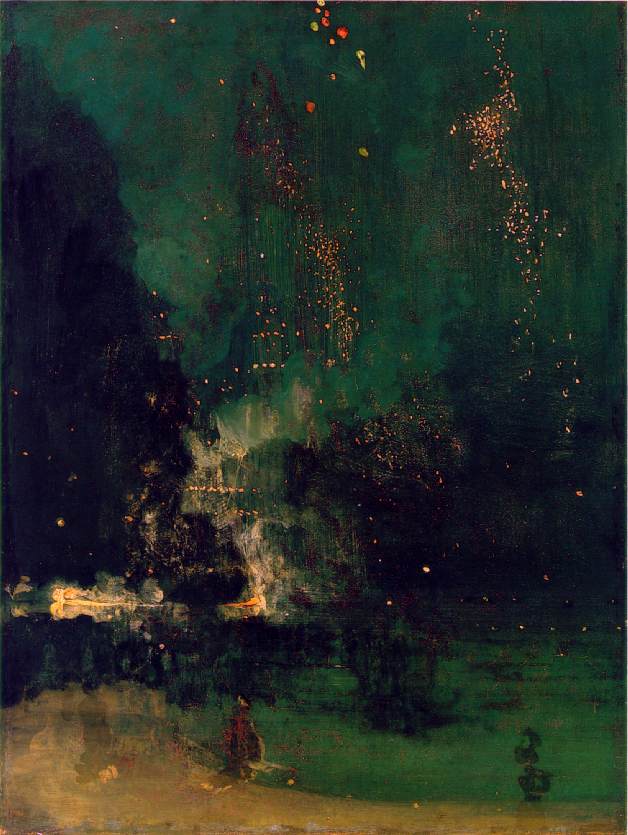
In 1877 Whistler sued the critic John Ruskin for libel after the critic condemned his painting Nocturne in Black and Gold: The Falling Rocket. Whistler exhibited the work in the Grosvenor Gallery that year alongside Edward Burne-Jones and others, and was reviewed by Ruskin in his publication Fors Clavigera on the July 2nd, 1877. Ruskin praised Burne-Jones, whilst he attacked Whistler:
- For Mr. Whistler's own sake, no less than for the protection of the purchaser, Sir Coutts Lindsay [founder of the Grosvenor Gallery] ought not to have admitted works into the gallery in which the ill-educated conceit of the artist so nearly approached the aspect of willful imposture. I have seen, and heard, much of Cockney impudence before now; but never expected to hear a coxcomb ask two hundred guineas for flinging a pot of paint in the public's face.[citation needed]
The case came to trial the following year and was heard at the Queen's Bench of the High Court from November 25th to 26th 1878. The lawyer for John Ruskin, Attorney General Sir John Holker, cross examined Whistler;
(wiki... look there for sources...)
- Holker: "What is the subject of Nocturne in Black and Gold: The Falling Rocket?"
- Whistler: "It is a night piece and represents the fireworks at Cremorne Gardens."
- Holker: "Not a view of Cremorne?"
- Whistler: "If it were A View of Cremorne it would certainly bring about nothing but disappointment on the part of the beholders. It is an artistic arrangement. That is why I call it a nocturne...."
- Holker: "Did it take you much time to paint the Nocturne in Black and Gold? How soon did you knock it off?"
- Whistler: "Oh, I 'knock one off' possibly in a couple of days - one day to do the work and another to finish it..." [the painting measures 24 3/4 x 18 3/8 inches]
- Holker: "The labour of two days is that for which you ask two hundred guineas?"
- Whistler: "No, I ask it for the knowledge I have gained in the work of a lifetime."[3]
Saturday, August 23, 2008
The Bacchae/Euripides
___________________________
Chorus:
... What does it mean to live a life?
Can you hope for better than to rise above all warring,
Control what threatens you,
Defeat what oppresses you?
To be strong-
No, nothing is better
I choose that.
Life is a stormy sea,
Happiness is a harbour.
Finding your harbour is your life-work.
He is truly happy who succeeds in that life-work.
Some end rich, some poor,
Some are strong, some achieve nothing.
There are ten thousand hopes, then thousand dreams,
They may all come true- they may all vanish,
But happiness-
A man finds happiness when he lies every day
With those forces of the world on his side.
All hail to that man!
_________________________
Chorus: ...Live easy, live calm, and the storm can't wreak you-
_________________________
Chorus:
... He {Dionysos} hates the man who says no.
No to the day,
No to the night,
No to life, and no to all love-
Keep away from that kind,
They are too much for you, they will consume you.
There is another way, never named, never mapped.
But the unheard-of, untalked-of people follow it.
That way I choose- I say yes to it.
_________________________
Chorus:
The forces of life are seen in disguise,
A thousand disguises.
They make all things possible,
They guarantee nothing,
What you thought was forgotten, buried,
They conceive, and bring to birth again.
Today you have watched their power at work-
It never ends.

